


This week, Supreme Court accountability is not a policy debate — it is a matter of life and livelihood for real people: Justice Samuel Alito has reversed his own recusal practice to weigh in on a fossil fuel case that directly benefits his billionaire friend Paul Singer while he holds oil industry stock; the Supreme Court agreed to hear arguments in April on whether Trump can strip Temporary Protected Status from 350,000 Haitians and 6,000 Syrians who have built their lives here legally; and the Alabama Supreme Court ruled 6-3 that police may demand physical identification from anyone who gives what officers consider an "unsatisfactory" verbal answer — a ruling born from the 2022 arrest of Pastor Michael Jennings, a Black man stopped for watering his neighbor's flowers. These are not isolated stories. They are chapters in the same book: a judiciary shaped by decades of Federalist Society strategy, stripping rights from the vulnerable while shielding the powerful, and People Power United is not backing down.
Why the Grassroots Resistance Can’t Wait

💥 Your Power in Action: What You Can Do Today
⚖️ Take action: Tell the Supreme Court to enforce the new ethics code
🚫 Take action: Tell the Supreme Court: Trump is not above the law
📜 Take action: Tell Congress to pass the Supreme Court Ethics, Recusal, and Transparency Act
🗳️ Bonus action: Register to vote, vote in every election, and help your community do the same. Reproductive freedom is won and lost at the ballot box.
👑 Bonus action: Sign up for the next national No Kings Day of Action and show up in solidarity with everyone whose rights are under attack.

🏛️What’s Happening Right Now at the Supreme Court
🌊 Supreme Court Agrees to Hear TPS Case for Haitians and Syrians — and Declines to Strip Protections Immediately
The Supreme Court agreed to hear oral arguments in April on whether the Trump administration can end Temporary Protected Status for roughly 350,000 Haitians and 6,000 Syrians who have legally lived and worked in the United States for years. In a notable break from its pattern of granting the administration emergency shadow docket victories, the Court declined to immediately lift protections — meaning these families remain shielded for now, while the full legal question heads to argument. A final ruling is expected before the term ends in June. (Bloomberg)
Why It Matters for Democracy: The Supreme Court has ruled in Trump’s favor on emergency docket requests roughly 78% of the time since January 2025 — an extraordinary rate of executive deference that has alarmed legal scholars and grassroots advocates demanding court reform. That the justices did not immediately hand the administration another win is meaningful, but it is not victory. The April arguments will determine whether any court can check the president’s power to strip humanitarian protections from hundreds of thousands of people — and whether due process applies at all when the administration invokes national interest. For 356,000 families, this is not abstract law. Their lives, their children, and their futures rest on what nine unelected justices decide.
🪪 Alabama Supreme Court Expands Police Stop-and-Identify Power — After Black Pastor Was Arrested Watering His Neighbor’s Flowers
In a 6-3 ruling, the Alabama Supreme Court held that police may demand physical identification from anyone who gives what officers consider an “incomplete or unsatisfactory” verbal answer during a stop — a major expansion of the state’s stop-and-identify law. The case originated with the 2022 arrest of Pastor Michael Jennings, a Black man stopped by Childersburg police while watering a neighbor’s flowers; the 911 caller had described a “young Black male.” Jennings identified himself, explained the situation, and was confirmed by the neighbor who made the call — then arrested anyway for declining to produce ID. His charge was later dismissed. (Seattle Times)
Why It Matters for Democracy: The Cato Institute’s director of criminal justice called this ruling a “significant expansion of government power over people” — and that is exactly what it is. What happened to Pastor Jennings is racial profiling in practice: a Black man, innocent, confirmed so by the person who called police, arrested for asserting his rights. Now the Alabama Supreme Court has written that outcome into law, making it easier for officers to detain Black and Brown people who dare to say, I haven’t done anything wrong. This is what happens when state courts are filled through ideological pipelines that prioritize control over civil liberties. Judicial accountability reform isn’t only about SCOTUS — it runs all the way down.
⛽ Justice Alito Reverses His Own Recusal to Decide an Oil Case That Could Benefit His Investments — and His Billionaire Friend Paul Singer
Justice Samuel Alito participated in the Supreme Court’s decision to take up a landmark climate liability case — despite having recused himself from identical cases involving the same legal question as recently as January 2025. Alito holds between $60,007 and $245,000 in individual oil, gas, and coal company stocks, and up to $100,000 in a fund where Exxon is among the top holdings. Even more striking: one petitioner in the case, Suncor, is a company in which Alito’s friend Paul Singer — whose private jet Alito flew on to a luxury Alaska fishing trip he failed to disclose — holds over $2.3 billion in shares. Alito offered no explanation for changing course. (Slate)
Why It Matters for Democracy: Boulder, Colorado has spent eight years fighting to hold Suncor and Exxon accountable for climate damages — including a 2021 fire that destroyed more than 1,000 homes. If Alito participates and sides with the fossil fuel industry, that ruling could effectively end dozens of similar climate accountability lawsuits nationwide. This is dark money judicial capture made visible: a justice with oil stocks, a billionaire friend with billions invested in the petitioner, a nonbinding ethics code that cannot compel him to step aside, and no public accounting required. An NBC poll this month found 38% of registered voters have very little or no confidence in the Supreme Court. That number will not improve until there is a binding, enforceable ethics code with real consequences — and People Power United will not stop demanding one.

⚖️ WHY THESE STORIES MATTER
Pull back and the pattern becomes impossible to ignore. Justice Alito refuses to recuse from a case where his stock portfolio and his billionaire friend’s $2.3 billion investment are directly at stake — and there is no authority that can force him to. Pastor Michael Jennings was arrested for watering flowers while Black, confirmed innocent by the very neighbor who called police, and the Alabama Supreme Court has now enshrined the logic of that arrest into law. And 356,000 Haitian and Syrian families are waiting to learn whether a president can terminate their legal right to exist in this country with no meaningful judicial check. These are not separate crises — they are one crisis, built brick by brick over forty years by a Federalist Society pipeline designed to place ideological loyalists on every bench in America, from state courts to the Supreme Court, where they answer to no one.
The good news — and there is good news — is that courts are still pushing back. The justices declined to hand the Trump administration an immediate emergency win on TPS. Lower court judges are still issuing rulings that protect people. And the grassroots movement demanding term limits, court expansion, and a binding ethics code is louder and larger than it has ever been. Reform does not come from the top. It is built from below, the way every meaningful advance in American history has been built — by people who refused to accept that power could operate without accountability. That is us. That has always been us. Keep going.
🔷 The Path Forward — and Your Role In It

⚖️ How We Restore Accountability and Demand Supreme Court Reform
A Supreme Court without accountability doesn’t just fail the people — it actively transfers power from the many to the few.
This is why expanding the Court, establishing 18-year term limits, and adopting a binding ethics code with real enforcement aren’t radical demands. They are the minimum conditions for a judiciary that can legitimately claim equal justice under law.
Expand the Court to restore balance
Set term limits to end lifetime partisanship
Adopt a binding ethics code with real enforcement
Reform isn’t radical — it’s necessary.
Take Action: Tell Your Member of Congress: Expand the Supreme Court to protect our voting and civil rights, create term limits, and institute a code of ethics
Justice belongs to the people.
Together, we can champion our rights, freedoms, and democracy, hold our leaders accountable to the people’s will, and inspire voters to make a meaningful difference.
Laurie Woodward Garcia (paid with hugs and kisses, not bought by special interests) Leader, People Power United
People Power United | In this community, we will always speak out against racism, xenophobia, Islamophobia, antisemitism, homophobia, misogyny, sexism, ageism, ableism, sizeism, elitism, transphobia, misogynoir, and bigotry!
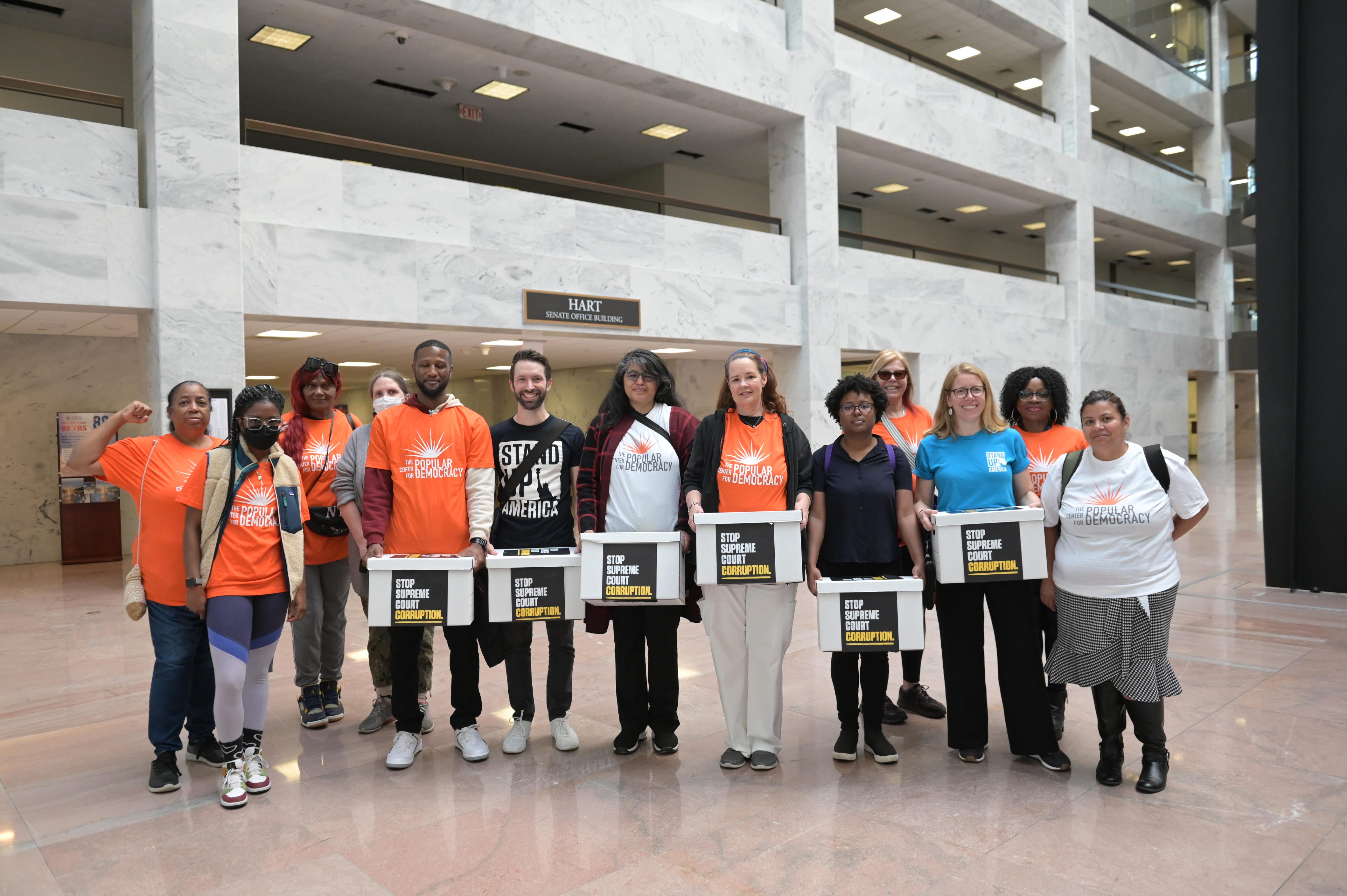
This is our moment to rise, resist, and reclaim our rights, freedoms, rule of law, and democracy. Millions of Americans are already refusing to back down — in the streets, at the ballot box, and in their communities.
Every movement that was ever won started with people who refused to quit. We are those people.
The future is not lost. It is being built — by us, right now.