

🏛️ What’s Happening Right Now at the Supreme Court
The Supreme Court stepped into two major election disputes this week, blocking new mail-ballot restrictions from taking effect before the midterms and pausing Missouri’s attempt to use newly drawn congressional districts.
Meanwhile, lower federal courts are confronting questions about executive authority, immigration, and whether the public can easily see what is happening inside the federal judiciary.
🏛️ The Courts Are Drawing Lines Around Power
Courts do more than decide abstract legal questions. Their rulings can determine which election rules apply, which government actions can move forward, and how much access the public has to the justice system.
This week provided four unusually clear examples.
The Supreme Court stopped a last-minute change to mail-ballot procedures. It intervened again in Missouri’s redistricting dispute. A federal judge blocked new restrictions affecting international students and journalists. And the Associated Press sued the federal judiciary itself, arguing that an existing rule keeps important immigration court records unnecessarily difficult to access.
Different cases. Different legal questions.
But one shared principle keeps surfacing: Power needs rules, review, and public scrutiny.
📬 Supreme Court Keeps New Mail-Ballot Restrictions on Hold
The Supreme Court declined to let the Trump administration enforce new Postal Service requirements for mail ballots before the November midterms. The disputed rules would have required states to use Postal Service-approved envelopes and provide voter information through a federal system. Justices Samuel Alito and Clarence Thomas dissented, while Justice Brett Kavanaugh wrote separately about the timing and legal issues surrounding the request. The underlying legal questions are not necessarily finished. Reuters
Why it matters: Election rules changed close to voting can create problems for voters and election administrators alike. The Court’s emergency order leaves current procedures in place for now.
🗺️ The Court Steps Into Missouri’s Redistricting Fight Again
The Supreme Court also paused a federal-court order that would have allowed Missouri to use congressional districts adopted in 2025. That leaves the state’s 2022 congressional map in place for the upcoming election while litigation continues. The dispute has bounced among state and federal courts and created uncertainty for candidates, election officials, and voters. Roll Call
Why it matters: Who draws congressional districts and when courts can change election rules are not technical questions. They determine the boundaries under which millions of people vote.
🎓 Federal Judge Blocks New Limits on International Students and Journalists
A federal judge in Massachusetts temporarily blocked a Department of Homeland Security rule that would have replaced the long-standing “duration of status” system for many foreign students, exchange visitors, and journalists with fixed admission periods. The judge concluded that the government had not adequately justified the change; the administration has defended tighter limits as necessary to prevent abuse. The litigation continues. Reuters
Why it matters: Lower federal courts remain one of the main places where executive actions are tested against statutes, agency procedures, and constitutional limits.
🔎 The Associated Press Sues the Federal Judiciary Over Court Transparency
The Associated Press filed suit against the Administrative Office of the U.S. Courts, challenging a rule that prevents remote electronic access to many immigration-related habeas filings. The AP argues the policy makes it unnecessarily difficult for journalists and the public to follow cases involving people who claim they are being unlawfully detained. These are allegations that a court will now evaluate. Bloomberg Law
Why it matters: Courts exercise enormous public power. Meaningful accountability becomes harder when important court records are difficult for the public and journalists to examine.
⚖️ Why These Stories Matter
This week’s cases are not all about the same law, but they raise the same accountability question:
Who gets to exercise government power, and what happens when someone challenges that power?
The mail-ballot and Missouri cases show courts intervening in election disputes when deadlines are already close. The student-visa case shows a lower court scrutinizing how an agency justified a sweeping regulatory change. The AP lawsuit turns the accountability lens back onto the judiciary itself.
That last point matters.
Judicial independence is important. So are transparency, clear ethics standards, access to court records, reasoned decisions, and public confidence that the same rules apply regardless of who holds power.
Accountability should not depend on whether we personally like the outcome of a particular case.
It should be built into the institution.
👀 What We’re Watching
More election cases: Voting is approaching, and the Supreme Court has already handled multiple emergency disputes involving election administration and congressional maps. Additional election-related requests could reach the justices before November.
The Court’s next term: The new Supreme Court term begins in October, with briefs and emergency applications already shaping cases involving civil rights, government power, health care, and other major constitutional questions.
📣 One Accountability Action
The Supreme Court allows the public to subscribe to individual case dockets and receive email notifications whenever a new filing or Court action occurs. That means we do not have to wait for social media commentary to learn what happened.
Search and follow Supreme Court cases directly
Read the order. Follow the docket. Check the source. Then decide what you think.
That is accountability too.
💙 One Thing to Carry With You
Courts can feel distant.
They are marble buildings, dense opinions, legal language, emergency applications, and decisions most people will never read.
But the consequences are not distant.
They reach our ballots. Our schools. Our families. Our speech. Our privacy. Our workplaces. Our freedoms.
And accountability does not require every person to become a constitutional lawyer.
It begins with something much simpler:
Pay attention. Ask questions. Demand transparency. Know what power is being used in our name.
Courts are powerful institutions.
The public still has the power to watch them.
Together, we can champion our rights, freedoms, and democracy, hold our leaders accountable to the people’s will, and inspire voters to make a meaningful difference.
One last ask, please take a minute to send to this to your member of Congress:
Laurie Woodward Garcia (paid with hugs and kisses, not bought by special interests) Leader, People Power United
People Power United | In this community, we will always speak out against racism, xenophobia, Islamophobia, antisemitism, homophobia, misogyny, sexism, ageism, ableism, sizeism, elitism, transphobia, misogynoir, and bigotry!
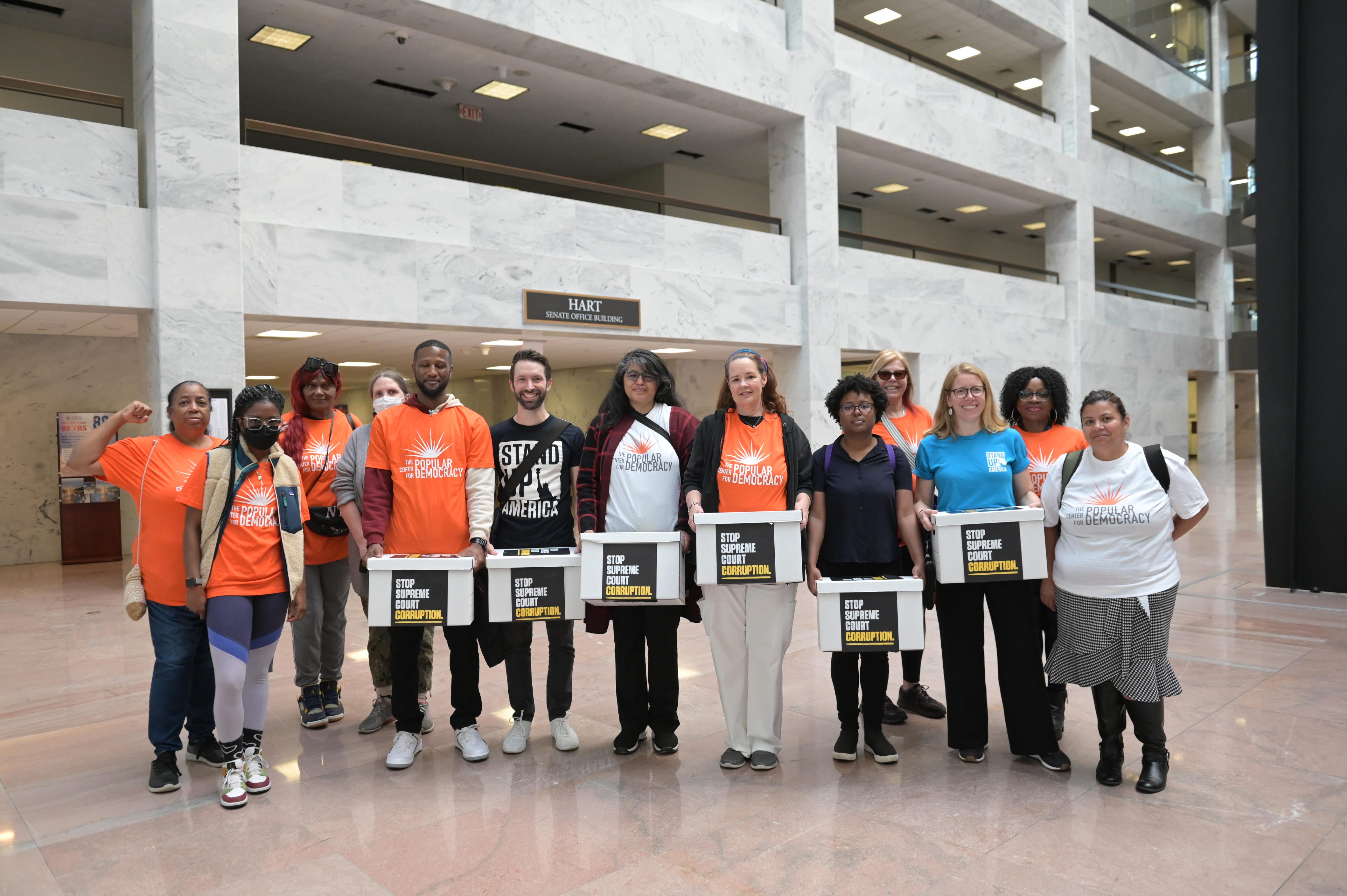
This is our moment to rise, resist, and reclaim our rights, freedoms, rule of law, and democracy. Millions of Americans are already refusing to back down — in the streets, at the ballot box, and in their communities.
Every movement that was ever won started with people who refused to quit. We are those people.
The future is not lost. It is being built — by us, right now.