🏛️ What’s Happening Right Now at the Supreme Court
The Supreme Court issued two consequential election-related orders this past week, allowing an expanded federal voter-verification system to resume while blocking Missouri from changing congressional maps after voting had already begun.
At the same time, Justice Ketanji Brown Jackson publicly questioned how the Court is using its emergency docket, while the Trump administration returned to the justices seeking permission to resume a disputed third-country deportation policy.
🏛️ The Courts Are Drawing Lines Around Power
Courts do more than decide abstract legal questions. Their rulings can determine which election rules apply, what protections people receive, and how quickly government policies can take effect while lawsuits continue.
This week provided four unusually clear examples. Different cases. Different legal questions.
But one shared accountability question keeps surfacing: How should enormous government power be exercised when courts are making consequential decisions before cases receive full review?
🗳️ Supreme Court Lets Expanded Voter-Verification System Resume
The Supreme Court on Friday allowed the federal government to resume using an expanded version of the SAVE database for voter-eligibility checks while litigation continues. The system allows states to compare voter information against federal records, including Social Security data. A lower-court judge had blocked the expansion over statutory, privacy, and reliability concerns. The Court’s three liberal justices dissented. The underlying lawsuit challenging the program has not been resolved. Reuters
Why it matters: An emergency Supreme Court order can change how states conduct voter-eligibility checks just weeks before an election, even while the legality and reliability of the underlying system remain disputed.
🗺️ Supreme Court Blocks Missouri’s New Congressional Map Again
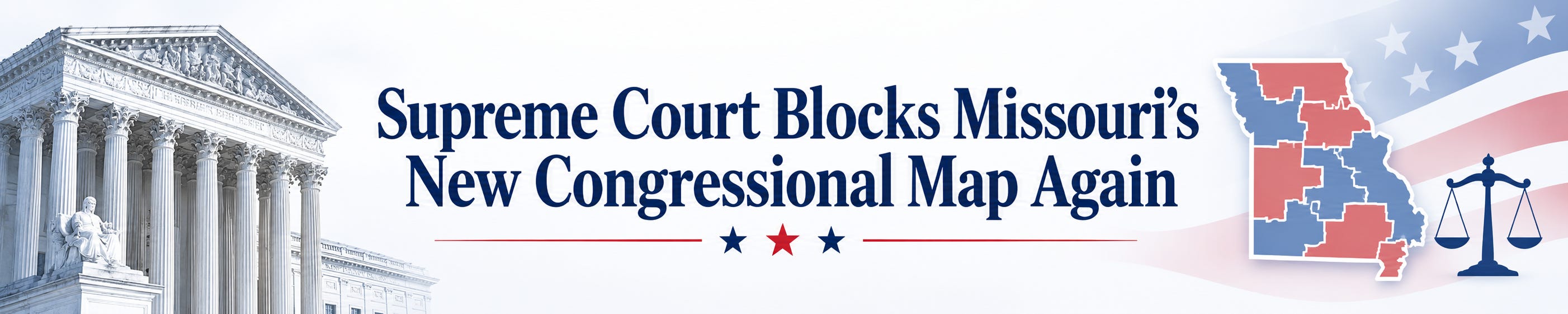
The Supreme Court also ruled Friday that Missouri cannot use congressional districts adopted in 2025 for the November election. With absentee, military, and overseas voting already underway using the older map, the justices said another last-minute change risked creating electoral confusion. The unsigned ruling had no noted dissents and relied on the principle that federal courts generally should avoid changing election rules close to Election Day. Bloomberg Law News
Why it matters: The ruling settles which congressional boundaries Missouri voters will use this November and underscores how election timing can shape whether courts intervene, regardless of the unresolved arguments surrounding a disputed map.
⚡ Justice Jackson Questions the Court’s Emergency-Docket Practice
Justice Ketanji Brown Jackson used a public appearance Thursday to criticize the Supreme Court’s increasingly consequential use of its emergency docket. She argued that major decisions issued without normal briefing, oral arguments, or extensive explanation can affect litigants and public confidence in the judiciary. Other justices have defended emergency intervention as sometimes necessary, and Justice Elena Kagan has said the Court has improved its explanations in these cases. The Washington Post
Why it matters: Judicial accountability is not only about outcomes. How decisions are made, how fully they are explained, and whether the public can trust and understand the Court’s reasoning matter too.
🧳 Another Deportation Dispute Reaches the Supreme Court
The Trump administration filed an emergency request asking the Supreme Court to revive its policy allowing some migrants to be deported to countries other than their countries of origin. Lower courts required immigration officials to provide notice and an opportunity to challenge removal to a third country. The administration argues those requirements interfere with its immigration and foreign-policy authority. Justice Jackson gave attorneys challenging the policy until Monday afternoon to respond. The Guardian
Why it matters: The case asks the Court once again to decide, on an emergency basis, what procedures must apply while a major dispute over executive authority and individual due-process protections continues.
⚖️ Why These Stories Matter
This week’s cases are not all about the same law, but together they show how much can happen through the Supreme Court’s emergency docket.
One order affects a federal system states can use to review voter eligibility. Another determines which congressional districts Missouri will use in November. A justice is publicly questioning how frequently the Court makes consequential emergency decisions. And the administration is asking the justices to intervene again in a dispute involving deportation and due process.
The common question is bigger than any single outcome:
How is power being exercised, what rules govern it, and how much explanation does the public receive?
Judicial independence matters. So do transparency, consistent procedures, access to court records, reasoned decisions, and public confidence that the same legal standards apply regardless of who holds power.
Accountability should be built into the institution.

👀 What We’re Watching
The voter-verification litigation: Friday’s order allows the expanded system to operate for now, but the underlying legal challenge continues.
The third-country deportation case: The challengers are due to respond to the administration’s emergency, putting another consequential dispute directly before the justices.
The Court’s new term: The Supreme Court’s October Term 2026 argument session begins October 5, bringing a new round of cases before the justices even as emergency applications continue arriving. Supreme Court
📣 Accountability Actions
Democracy depends on people paying attention. Justice should serve everyone, not only those with wealth or privilege.
🔎 Follow the Court directly: The Supreme Court allows the public to follow individual case dockets and review filings, orders, and other developments. Search and follow Supreme Court cases directly
⚖️ Take Action» Tell Your Member of Congress: Expand the Supreme Court to protect voting and civil rights, create term limits, and institute a code of ethics.
Pay attention. Follow the decisions. Demand transparency. Hold power accountable.
💙 One Thing to Carry With You
Courts can feel distant, but their decisions reach our ballots, families, workplaces, privacy, and freedoms.
Accountability starts simply:
Pay attention. Ask questions. Demand transparency. Know what power is being used in our name.
Courts are powerful institutions, but the public still has the power to watch them and hold that power accountable.
Small actions become collective power when millions of people show up.
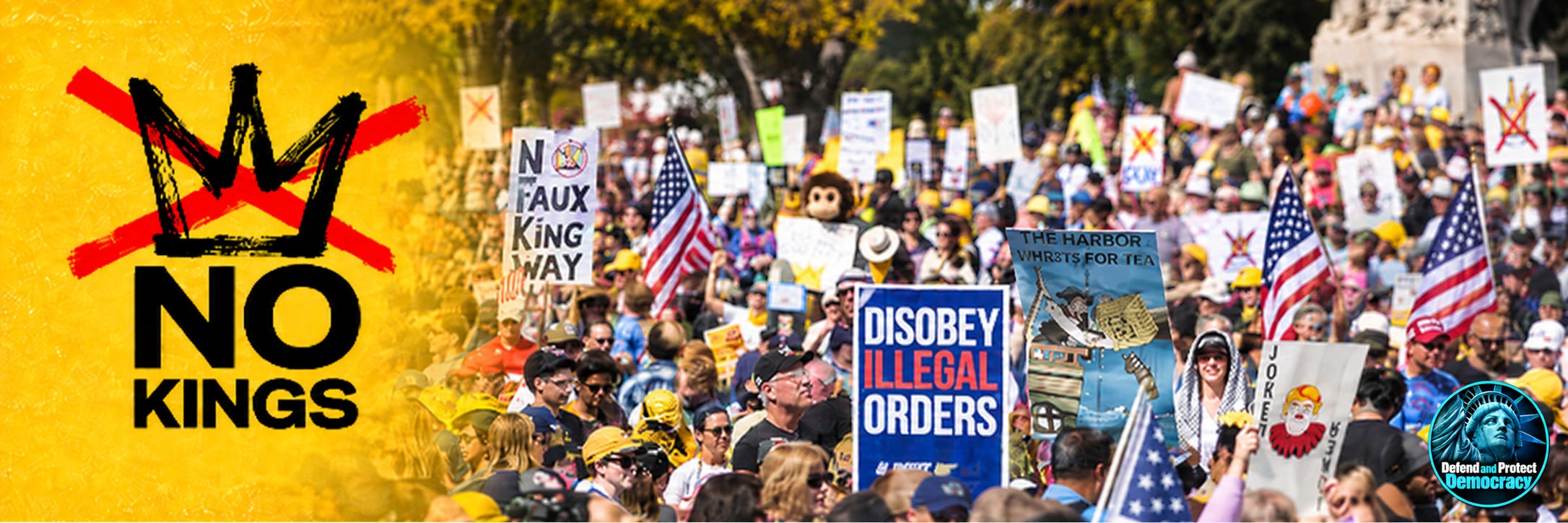
We are not powerless. And we are not alone.
Now we carry that energy from the streets to the ballot box.
Voting early is one of the simplest ways to make sure our voices are counted while helping our friends, families, and neighbors create their own voting plans.
On October 17, communities nationwide will come together for No Kings: Vote Early.
Whether you have joined every No Kings action or this is your first time stepping forward, there is a place for you.
HOW TO GET INVOLVED
📍 Find a No Kings: Vote Early event near you
🙋 Host a No Kings: Vote Early event
Can’t find an event near you? Bring one to your community. Gather your neighbors. Help make sure every voice is heard.
This is our moment to rise, resist, and reclaim our rights, freedoms, rule of law, and democracy. Millions of Americans are already refusing to back down — in the streets, at the ballot box, and in their communities.
Every movement that was ever won started with people who refused to quit. We are those people.
The future is not lost. It is being built — by us, right now.
Laurie Woodward Garcia (paid with hugs and kisses, not bought by special interests)
People Power United | In this community, we will always speak out against racism, xenophobia, Islamophobia, antisemitism, homophobia, misogyny, sexism, ageism, ableism, sizeism, elitism, transphobia, misogynoir, and bigotry!